Tuesday, June 20, 2006

Kid Lit

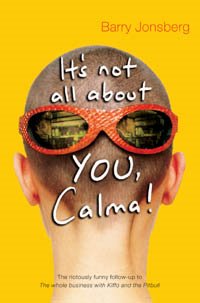
I am currently trying to devour as much adolescent fiction as possible before I return to school and begin doing the 'book talk' for year 7 and 8 library classes. I want to make the most of this opportunity to develop a pretty decent understanding of this area of my practice, which I think is a bit lacking at the moment. I know my harry potters and my philip pullmans and my margo lanagans (my two most recent new loves) and I know what was around when I was fifteen, but I don't really think that is going cut it anymore. I love talking to my students about what they're reading, and the more I know, the better I'll get at it. I love recommending a book to student in the library and watch them sink into a cushion and begin to devour it.
The problem is that the librarian that I am filling in for has a better grasp of young adult fiction than anyone I've ever met. I don't know how she does it- she knows her library and every book in it like the back of her hand. I know that I don't have a hope of living up to that, but I want to give it my best shot. Hence wishing that one could read an entire novel by simply placing one's hand on the cover until the words unstick themselves from the pages. Hey presto, one book down- next! I've tried it- it doesn't work. I have a feeling that the Inside a Dog website and I will become very well acquainted, as I try furiously to keep up with my reading.

My list for the hols:


I'm going for the 'eclectic' approach. I'm currently reading this:


which I am enjoying, particularly the use of musical imagery in the voice of one of the narrators.


But I really want to be reading this:


and especially this


Unfortunately, the students must have beaten me to it, since I couldn't find them on the shelf. ;)

Monday, June 19, 2006

pictures of words

A scarlet letter

P o E M - Lankershim Arts Center

Cimetière Montparnasse S p.e.r.i.o.d p.e.r.i.o.d

scattered seed-pods


There were sea-horses and mer-men

and a flat tide-shelf,

there was a sand-dune,

turned moon-ward,

and a trail of wet weed

beyond it,

another of weed,

burnt another colour,

and scattered seed-pods

from the sea-weed;

there was a singing snail,

(does a snail sing?)

a sort of tenuous wail

that was not the wind

nor that one gull,

perched on the half-buried

keel,

nor was it any part of translatable sound,

it might have been, of course,

another sort of reed-bird,

further inland;

inland, there was a pond,

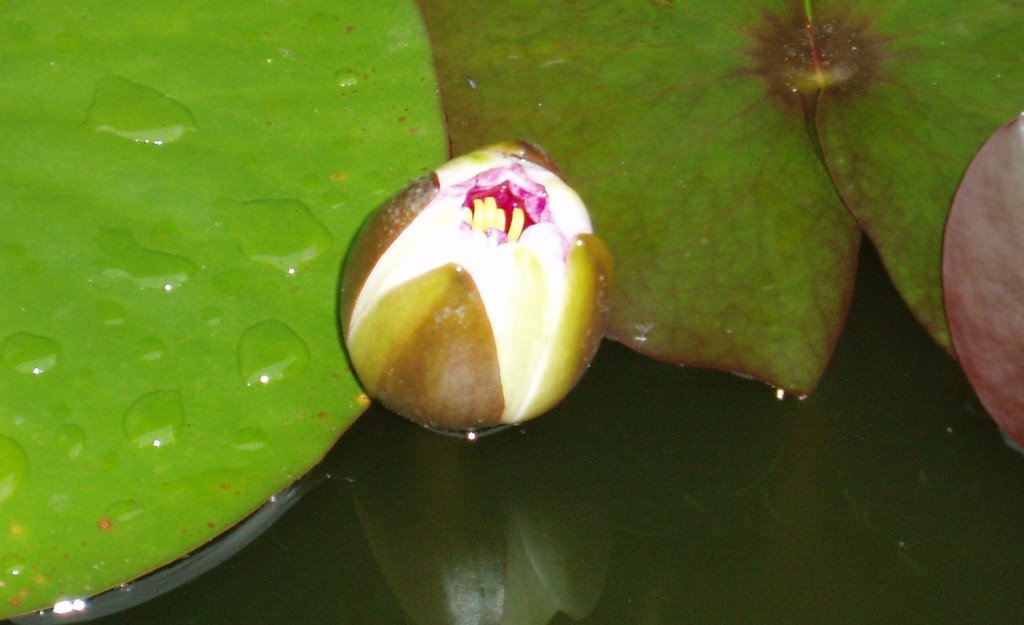
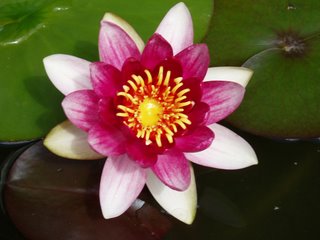
filled with water-lillies;

they opened in fresh-water

but the sea was so near,

one was afraid some inland tide,

some sudden squall,

would sweep up,

sweep in,

over the fresh-water pond,

down the lilies;

that is why I am afraid;

I look at you,

I think of your song,

I see the long trail of your coming,

(your nerves are almost gone)

your song is the wail

of something intangible

that I almost

but not-quite feel.

- "The Poet", H.D.


I want to write with this kind of mystery...

Tuesday, June 13, 2006

Looking forward...

At the moment it is difficult to stay focused on my thesis (even though I am getting closer and if I keep at it I will have it written soon) because the thought of returning to teaching in a month's time is distracting me. I am returning to a fantastic load (year 10 and 11 literature, year 10 English and some classes in the library delivering the wider reading program). On a version of the timetable a month or so ago I was going to be teaching year 8 English workshop (an 'intensive' program for students who find some aspects of English a bit challenging), which I was looking forward to because it is a small class and I was excitedly thinking of new things to explore with them, such as digital storytelling, which would be manageable in a group that size and a potentially fabulous experience for them.

Unfortunately, on the latest version of the timetable this class clashes with year 11 lit, hence picking up the wider reading program for the librarian who will be on leave. I'm really glad to be part of the wider reading program though, because what could be better than chatting to kids about what they're reading? It will give me the incentive to really broaden my knowledge of what is out there in adolescent literature at the moment, too, as this is an area of my practice that I would really like to develop.

Very excited about finally teaching year 11 lit, too, after making the wrenching decision to put this on hold to take some leave at the start of the year. They've been incredibly good to me- I'm lucky to be getting this class back, and feel badly for the teacher who is really enjoying these students and is having to pass them back to me. He will be a great support, though, and I know a few wonderful people I can/will ask for advice. I am beginning to feel the pressure of living up to the good work that has already been done, while at the same time wanting to explore some of my own ways of doing things.

So, lots to look forward to...

...teaching literature... teaching the only year 11 class, which means I can dance to the beat of my own drum... having another go at blogging in the classroom (hopefully with more success this time around)... playing/experimenting with students and some wonderfully fun social software resources, like this, this, this, this and these... chatting about 'the kindness of strangers', tygers, 'janeites', and the prodigiously wealthy... reading books on soft, plump cushions... getting the school creative writing mag up again, and hopefully satisfying my vision of turning it into a creative arts e-zine, complete with podcasts of students reciting their own poetry, recordings of school bands (established and subversive), photos of artwork, films of student media projects, short stories (yes, well, ok, this vision might take until next year- probably safer to start small)... turning this blog into something a little more dynamic that is a more complex, interesting reflection of my teaching self... and teaching again (sigh)...

Tuesday, May 30, 2006

Which female literary character are you?!


Which Classic Female Literary Character Are you?


You're Elizabeth Bennett of Pride and Prejudice by Jane Austen!
Take this quiz!


Quizilla |
Join

| Make A Quiz | More Quizzes | Grab Code

Sunday, May 28, 2006

Student voices

I spent a couple of days last week getting paid for listening to kids talk- a pretty nice way to earn some extra money, if you ask me. At my school, the year 12 students present their English orals to an external assessor (ie, me, since I'm on study leave) and a small group of their classmates, rather than during class time. It takes about a week to get through them all because they are allocated a time during one of their free periods so they don't miss any classes. I'm sharing the marking load with S, who is a brilliant retired English and lit teacher. We marked together on the first day (I was only supposed to stay an hour or so in the morning for crossmarking purposes, but we were enjoying working together so I ended up staying for most of the day) and now we are alternating days until we get through them all by the end of this week. The 'system' works pretty well, although it pales in comparison to the organisation that would be needed to get through them all in one Saturday, like Jo did. But I don't think that would work for us- we would probably need to run some bus services to get all the students into school, because they come from miles around.
Anyway, I love doing the orals. I miss out on teaching this group in their final year since I am on leave this semester, so it's nice to be involved in their last year of English, albeit in a small way. They blow me away- they do an amazing job in their presentations and I can't help smiling and nodding at them the whole time, but most impressive is the way that they (without exception) support each other as audience members. So, yes, I'm enjoying myself, although I will admit to feeling a little over hearing about the dangers/potentials of nuclear energy and the growing obesity epidemic in young Australians. But that's ok- there's enough variety because they can talk about a current issue of their choice or develop a topic relating to one of the set texts (I got to see an impressive dramatic monologue based on a character in Rayson's Inheritance the other day).
I haven't yet spent much time thinking about the return to school next semester- busy stressing over my masters- but I am starting to allow small seeds of excitement to germinate. I'm feeling very happy about my load- as long as I got my wonderful year 11 lit kids back I was going to be thrilled- but year 10 lit has been a somewhat unexpected bonus, and the teasing possibility of some hours in the library delivering the wider reading program to year 7s and 8s (depending on the final shape that the timetable settles in) is like the rainbow sprinkles on a decadent chocolate cake.

... I was wondering this morning what a reader who doesn't know me would make of this hodgepodge of a blog- this somewhat bizarre concoction of discordant notes that even I don't know what to make of. I lurch from one entry and/or pseudo genre to the next with no explanations, noticeable development or direction. I think I've shifted at some point or other from being preoccupied with the thought of an audience and who/what it consisted of to just letting this blog extend into whatever direction it wants to. Oh well. That's probably a good thing (or at least an interesting thing). I think that I do need to work on making these entries more 'bloggish' though, in terms of being hyperlinked and thus connected and multi-dimensional. Hypertext was one of the elements that most appealed to me about blogging to begin with, but it has slipped off my radar screen of late. Hmmm...

Monday, May 22, 2006

Discourse

I tried to speak in your tongue but

My mother tongue is Maeve Binchy novels and ginger fluff sponge, early morning dreamings on the back step, porcelain owls and zygo cacti

My father tongue is quartz and sandstone, toy planes fashioned from beer cans and a Stanley knife, framed photos of black and white beaches

I hear your words and I want them, desperately, but when I try to catch them and pop them in my mouth they splinter and I bleed

So it must be best to leave them in the air

Drifting past my closed lips

Your words are a tapestry; precise and intricate on the surface but turn it over and you can see the garbled mess of knots and listless strands of surplus thread…
So you frame it and nail it to the wall above the striped couch and that’s that- the Symbolic hides the semiotic.

Which should be comforting but it’s not

The semiotic is where my nan has retreated since that imp named Alzheimer’s perched on her shoulders, supping on her memories with a silver spoon. It is the ‘how tos’ and the ‘what fors’ he has crunched and slurped with particular relish- he is saving the precious faces, loving voices and faded wedding photos for last

Teetering,
see-sawing,
I hope

some days that he will keep jabbing with his spoon for the chink of useless phone numbers and the clink of scone recipes (as though hunting for glinting pence in the Christmas pudding)

other days I pray that he will hurry up and finish his meal so that she can finally lose herself and return to the (M)other where it is warm and safe


these words were not supposed to arrive here

Saturday, May 20, 2006

Poetry is not a luxury


The quality of light by which we scrutinise our lives has direct bearing upon the product which we live, and upon the changes which we hope to bring about through those lives. It is within this light that we form those ideas by which we pursue our magic and make it realised. This is poetry as illumination, for it is through poetry that we give name to those ideas which are- until the poem- nameless and formless, about to be birthed, but already felt. That distillation of experience from which true poetry springs births thought as dream births concept, as feeling births idea, as knowledge births (precedes) understanding...
At this point in time, I believe that women carry within ourselves the possibility for fusion of these two approaches so necessary for survival, and we come closest to this combination in our poetry. I speak here of poetry as a revelatory distillation of experience, not the sterile word play that, too often, the white fathers distorted the word poetry to mean- in order to cover a desperate wish for imagination without insight.
For women, then, poetry is not a luxury. It is a vital necessity of our existence. It forms the quality of the light within which we predicate our hopes and dreams toward survival and change, first made into language, then into idea, then into more tangible action. Poetry is the way we help give name to the nameless so it can be thought. The farthest horizons of our hopes and fears are cobbled by our poems, carved from the rock experiences of our daily lives.

-Audre Lorde

Friday, April 21, 2006

'Rubbish', ay?

Dearest Johnny,

I heard what you had to say about educational stuff yesterday. And don't you worry, I didn't believe a word those nasty people said about you knocking teachers just to get the media off your back about the AWB. I believe you, mate, I know that if you said you didn't read those diplomatic cables then you didn't read them. You're a busy man, after all. And I know you'd rather spend your time reading the classics, like that chap Shakespeare's book, Julius Caesar. Or Macbeth. Or King Lear, perhaps.

Schools these days, ay? You send ya kid along to one of these places for a bit of schoolin’, and they come home spoutin’ that Communist bloke and tellin’ their own flesh and blood that they don’t need to mow the lawn no more because they’ve given away the back yard to the aborigines as a ‘reconciliatory gesture’. And, I don’t want to alarm you or nothing Johnny me ol’ mate, but they’re spreading all kinds of porky pies about you. All this stuff about kids falling off boats, workers getting sacked for coming to work, and something unmentionable about you and Indonesia’s behind.

I just thought I’d better warn you, Johnny, because the stuff schools are teachin’ these days is pretty outrageous, especially the public ones. And they’re getting organised. Yep, kids are tapping away on them new fangled mobile phones all over this sunburnt country in a secret code (most likely akin to something the Enemy used during the war, I reckon) that no one else understands. ‘Txting’, they call it. Technology and such has got a lot to answer for, if you want my opinion.

Face it, Johnny, you’ve got to get yourself prepared. Head down into that underground bunker that I know you’ve got hiding beneath Canberra somewhere and watch your back. Take your mates Pete and Nelson with you, ‘cause those crazy kids have got marks on their backs too, from what my sources tell me. Believe me, mate, they’re heading your way in droves. Rows and rows of ‘em, marching, chanting, “Marx, Marx, Marx!”. Sends shivers down my back, it does.

And you know where they’ve learnt all this ‘rubbish’, don’t you Johnny? Yep, you betcha Union Jack you do. After all, you saw it coming, didn’t you? You knew that the day those schools started thumbing their noses at ‘real’ Shakespeare and switched to studying ‘rubbish’ that it was all going to end this way. Ah, the good old days. They should have listened to you, not those ‘trendy’ postmodern professors. ‘Critical literacy’ my ass. Kids should be taught to know their place, and not run around questioning everything. They should be taught the truth, the whole truth, and nothing but the truth.

Yep, you’ve hit the nail on the head, Johnny, I reckon. Those so called ‘independent’ education authorities better listen to you, if they know what’s good for ‘em. Say, maybe you oughta cut some more of their funding, just to keep them in line, you know? That’ll teach ‘em. Or, try ‘negotiating’ with them like you did with that flag thing a while back. Cut them out of the good stuff unless they hang a picture of you in every classroom. That’ll remind ‘em what real Australian values are. None of this ‘multicultural’ crap.

Yeah, you’re right Johnny, education sucks in this country. The states suck, the teachers suck, the new fangled ‘texts’ (what’s wrong with ‘books’ anyhow?) suck. Fancy those educators wanting to develop our young people into alert, interested and compassionate citizens who can place themselves in someone else’s shoes and understand that there is always more than one side to any story. What sort of country would want a citizenry like that? Yep, you’ve got the answer, Johnny. Drones all the way, I say.

Tuesday, April 11, 2006

Go team

I am going to school to help out with the athletics carnival tomorrow- It's giving me flashbacks of my own school days... I'm fifteen again...

The annual compulsory athletics carnival on the oval that nothing short of a death certificate would save you from. I remember them well. Sitting behind ropes watching people run by was not my idea of fun and all my friends were in other houses wearing respectable colours like 'red' and 'blue' not 'white' which, by the way, is not actually a colour, but try telling that to teachers, and what can you do with 'white' anyway, I mean besides wrapping your body in rolls of toilet paper which many students did in my house- the kids with the sparkly red tinsel in their hair on the other side of the flimsy rope that you couldn't cross because if you did you would be hauled back to the patch of grass where all the crazy toilet paper people were must have been laughing at us, but what else was there to do but throw toilet paper around, because if you tried to do something like, oh I don't know, READ A BOOK the school 'protocol officer' would be sure to loom above you without warning and take it from you because that wasn't showing team spirit, even if you argued that you were reading a biography of Mary MacKillop, the woman your house was named for and what could be more team spirited than that it wouldn't fly because he could read the cover and know you were actually reading Jane Eyre. And didn't anyone bother to tell the protocol officer (ex-Navy, I kid you not) that fascism is frowned on in most parts of the world these days, and what does it say about the school's philosophy if they actually think it's a good idea to hire someone for the position of 'protocol officer' (especially some guy with a buzz cut and military training) in the first place? But that's beside the point because the point is that kids whose only attempts to do a triple jump where when they accidentally tripped down the stairs had to sit there all day watching other kids run round and round and not even be allowed to reach into their backpacks to grab their discmans (it was the 90's)to add a soundtrack to the festivities or even resort to doing their homework which was also not allowed on aths day even though it was at school, and I hated it and I could actually run and even won a few ribbons (my best friend and I were fabulous at the 3 legged race, but they took the fun out of that when they cancelled novelty events from the program when I was in year 90), so if I hated it and I quite liked running, what was it like for the kids who hated athletics of any form with a passion, and besides, like I said so often back then, it's not like attending the school musical was compulsory, it's not like there was a school 'debating day' which everyone attended, or an 'art show' that everyone had to come along to, NOooo, the only compulsory activities were for the sports lovers which says quite a lot about a school's priorities if you ask me and fringe dwellers be gone, so there.


Note to reader: I am not really quite as bitter as I sound, just can't resist striving for comedic effect.

Thursday, March 30, 2006

Trobairitz and tensions

If it helped me, I’d remind you, singing,
that I had your glove,
the one I stole in fear and trembling:
then I feared
you would be harmed
by the lady who has your service;
so, friend, at once
I gave it back, because I know
I have no rightful claim.


-Castelloza, “Ia de chanter non degra aver talan”, Matilda Tomaryn Bruckner et al (trans.)


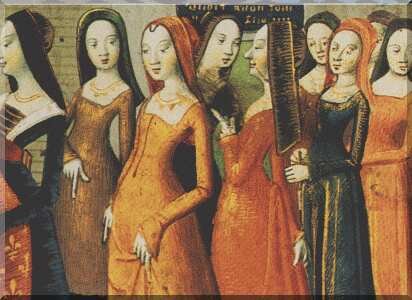
This post springs from some of the reading that I have been doing for my masters, which, as is often the case, resonates in other spaces that I occupy. I have been reading about women troubadours (trobairitz) from the Middle Ages. Only a handful of their writings survive, far less than those of male troubadours. These women write within and outside the tradition of fin’amor, in which the lowly poet begs for the love of a usually silent and distant lady, typically the wife of his lord. What I find interesting about this tradition is that it appears to put the lady in a position of power, during a time in history when you expect that women would have very little power at all. The courtly lady rejects the advances of luckless suitors from her pedestal, seemingly entirely in control. What the lyrics of love and pain obscure from the reader however, is the economic code they represent. Laura A. Finke describes fin’amor as “an ideology that smoothed over the contradictions brought about by homosocial competition to control women as resources… It represented aristocratic women as simultaneously on display and inaccessible” (Feminist theory, women’s writing, 1992). The apparently heartfelt poetry of fin’amor had more to do with economics than the love of women, in effect, the poems operated as coinage, a form of symbolic patronage between vassals and their lords. Thus, “the languages of poetry and of sexual desire existed in a dialogic relationship- entangled- with the languages of economics, warfare, and politics” (Ibid).

When women write within the codes, forms and symbols of this tradition, the results are subversive, exposing the power dynamics and struggles that the poetry was originally designed to hide. In the case of Castelloza, the trobairitz I quoted from above, she does not write from the position of a woman in power, and the effect is unsettling. She tries to write about subjects that the code of fin’amor was not designed for, and so her words, meanings and associations swell against the poem’s form, flooding the retaining wall of language.

This is important to me when I am trying to write the voice of a woman narrator who threatens the retaining walls of courtly discourse in a society where women’s speech is considered irrelevant at best. It is also interesting to think about when I am considering the value of having a voice in other conversations and spaces, particularly in spaces where the accepted discourse is somewhat inaccessible, or challenging. I find myself ‘trying on’ different discourses all the time, particularly in various teaching worlds, until they become comfortable. But then, I start to worry about why they have become comfortable, concerned that they slipped over my body like a soft, faded jumper without me noticing. I worry that I am becoming parrot-like, speaking in shared languages to make connections, even if I don’t truly understand the translation.

And so, the anxiety of mimicry leads me here, to think critically about the discourses that I hide behind, to develop my own critical understanding of them. Then, when I put them on again, I will feel at ease because although I’ll be wearing the same soft, faded jumper, I will be standing in my own doc martins.

Stay tuned.

Tuesday, March 21, 2006

Darkness

At the moment, words and writers are making patterns in my mind, though I cannot yet wholly see or understand the shape they form. I reach into the dark...

Into this wild abyss,
The womb of nature and perhaps her grave,
Of neither sea, nor shore, nor air, nor fire,
But all these in their pregnant causes mixed
Confusedly, and which thus must ever fight,
Unless the almighty maker them ordain
His dark materials to create more worlds...

-Milton, Paradise Lost, Book II, ll. 910-916


Finding yourself in a hole, at the bottom of a hole, in almost total solitude, and discovering that only writing can save you. To be without the slightest subject for a book, the slightest idea for a book, is to find yourself, once again, before a book. A vast emptiness. A possible book. Before nothing. Before something like living, naked writing, like something terrible, terrible to overcome.

-Marguerite Duras, Writing


The storyteller of the tribe puts together phrases and images: the younger son gets lost in the forest, he sees a light in the distance, he walks and walks; the fable unwinds from sentence to sentence, and where is it leading? To the point at which something not yet said, something as yet only darkly felt by presentiment, suddenly appears and seizes us and tears us to pieces, like the fangs of a man-eating witch. Through the forest of fairy-tale the vibrancy of myth passes like a shudder of wind.

-Italo Calvino, Cybernetics and Ghosts


In order to go to the School of Dreams, something must be displaced, starting with the bed. One has to get going. This is what writing is, starting off. It has to do with activity and passivity. This does not mean one will get there. Writing is not arriving; most of the time it's not arriving. One must go on foot, with the body. One has to go away, leave the self. How far must one not arrive in order to write, how far must one wander and wear out and have pleasure? One must walk as far as the night. One's own night. Walking through the self toward the dark.

-Helene Cixous, Three Steps on the Ladder of Writing


The moon had set by now, and the sky to the south was profoundly dark, though the billions of stars lay on it like diamonds on velvet. They were outshone, though, by the Aurora, outshone a hundred times. Never had Lyra seen it so brilliant and dramatic; with every twitch and shiver, new miracles of light danced across the sky. And behind the ever-changing gauze of light that other world, that sunlit sky, was clear and solid...
... And as he said that, the Aurora flickered and dimmed, like an anbaric bulb at the end of its life, and then went out altogether. In the gloom, though, Lyra sensed the presence of the Dust, for the air seemed to be full of dark intentions, like the forms of thoughts not yet born...

-Philip Pullman, Northern Lights, His Dark Materials trilogy


Saturday, March 11, 2006

Writing a tapestry

I've been thinking recently about the desire to pin down text like a struggling butterfly impaled on a collector's needle. At a meeting with a newspaper editor it struck me first- a journalist's necessary urge to 'find the story', as thought it can be separated from everything else. It hit again in a meeting with my masters supervisor- I need to articulate the central question that I am trying to answer through the story that I am currently (physically) writing. M was very good at this sort of thing- he could peel a text like an onion until he thought he had found its core, and wouldn't stop until he did. But I can't do it. Not for this story at least (not ever, I don't think... could this be a problem??)

I have tried to narrow it down, and this is what I am left with.

The story is about:

metamorphoses..... and...

the life cycle of the moth.... and this quote from Cixous,

"the painter is the one who takes the model's life" and consequently...

"The Oval Portrait" by Edgar Allan Poe, and so...

...creation/birth/death...

If music be the food of love... and so the


'mythomania' of love... romance... dancing... dining...

talking back to Tennyson...

...journeying... on and on... and on... what happens in the time between awakenings...

Sapsorrow, the Russian folktale...

my grandparents...

new epics...

Lizzie and Dante... Enid and Gereint...

...imagination/creation/inspiration...

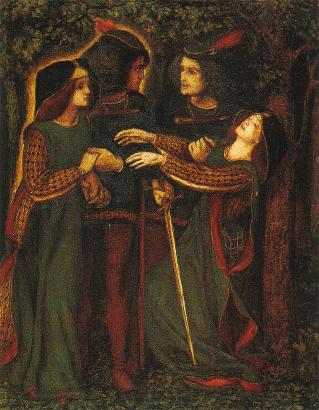
and this painting by Rossetti...


and this sketch by Lizzie...


and these words, by Margaret

You fit into me
Like a hook into an eye
A fish hook
An open eye.


See? I narrowed it down, though my jabbing pin has missed the butterfly...

Procastination... (hey, I wrote heaps today! I earned it!)


You Are A Maple Tree


There's not anyone in this world quite like you.

You are full of imagination, ambition, and originality.

Shy but confident, you hunger for new experiences.

You have a good memory and learn easily.

You are sometimes nervous and always complex (especially in love).


Wednesday, February 22, 2006

Back in the classroom...

I've been neglecting this blog terribly of late which is a shame because I want it to be a dynamic, intriguing, metamorphising space. I just haven't been feeling inspired enough to do anything about it, or rather any flashes of inspiration that I do have are being fed into other writing spaces. I want to do something about it though, so hopefully soon I will want it enough to actually do it. I should just write, rather than wait for the writing to happen. So...
I'm back in the classroom this week and it's fantastic. Ironically, I'm teaching more English classes this week while doing CRT work than I was last year with my own classes! Bizarre. My school has been really good about giving me mostly English classes, which is great for me because I get to do some real teaching and good for the students because they still get to spend time with someone who is keen to explore words with them, even though their 'real' teacher isn't there. So, I've been reading stories aloud with all the voices, teaching short story structure using The Simpsons, playing with Bruce Dawe and falling in love with "Katrina", talking with students about their favourite songs and chatting about writing folio ideas and Indiana Jones. Fun stuff.
I've spent a couple of days teaching in our new year 9 campus, a converted rope factory of all things, down the road from our senior campus. It's really beginning to grow on me, there's something wonderfully authentic about this learning space that has undergone its own metamorphosis from workplace to school ground. Industry leaving behind an empty space for learning. There are classes in magical sounding places like 'the ballroom' and students 'drop everything and read' below shady trees. It is a place of spaces, like the huge, echoing, musty hall that no one has decided what to do with yet, so at the moment the students use it to play cricket at lunchtime, hitting balls high into the rafters and sending them ricocheting from wall to wall. They couldn't possibly hurt a space like this, all they do is add to its history. I taught in the main hall, an enormous space without dividing walls, while another class carried on about 20 metres along the space. The kids were great. The walls are bright colours. The ancient wooden floorboards gleam. I like this place. It's not a fairy tale, but I like the spaces.

Saturday, February 04, 2006

Potential

I am attending the International Digital Storytelling Conference at ACMI over this weekend, so I will try to share my interpretation of some moments from it in the next few entries.

John O'Neal (playwright/actor/activist- amongst other things) opened the conference with tears and laughter in his voice. He spoke of many things that stirred me, particularly about the role of art and artists in activism and social change. Our stories are far richer than our arguments, he said. They reveal to us things that we don't even know ourselves.

In the classroom (and beyond), especially over the last twelve months, I have found myself particularly focused on helping students to be critically aware of the messages that bombard them- in advertising, in online environments, in written texts, in visuals, in moving pictures. I have encouraged them to be resistant readers, and to consider texts from other points of view. To resist the accepted lure, the hook, of the art that surrounds them.

This is important.

What I haven't consciously done in a while is to consider this notion from the other side- as a producer of text/art, rather than a consumer of text/art. John O'Neal spoke of the insidious power of art- the way that it achieves its impact on us beneath the level of our logical minds. Such art can have an impact on the way we think, without us necessarily being aware of it. This is how art has the potential to change- change us, change our society.

I want to be a producer of texts that hold this insidious power. Not only that, I want my students to not only be aware of text/art's potential for change, but to be able to use it to dessiminate their own messages.

Walking back to my car beneath swaying red lanterns, I seared with the importance of this.

Thursday, December 22, 2005

Any 'King's Quest' fans out there?


I'm hesitant to post this, because the extent of my geekdom will finally be revealed, but maybe it's too late to try and hide it, anyway.

I just found out today that a King's Quest IX will be released as freeware sometime next year! Hurrah! It is particularly exciting because it has been written by some ardent fans of the series who were disappointed that Sierra (the original developer) turned their back on the series after the disappointing sales of King's Quest VIII. (but it only failed because they left the essential ingredients of King's Quest- an interesting narrative, a sense of humour, and characters that you care about- behind to jump on the 'shoot em up/violence' bend of RPG's that is pretty much all that is left of this once great genre and that I have absolutely no interest in. Hmph.)

These fan fiction writers/developers are writing/designing a trilogy that ties together all the loose ends of the Kingdom of Daventry mythology once and for all. It should be fantastic because they will be keen to preserve the essence of the original games/stories. You can check out their website, if you're interested.


The King's Quest series would have to be included amongst the great narratives of my childhood. When I was about 7 or 8 my family 'baby-sat' my dad's friend's computer while he was overseas (before we got our own). He had the original King's Quest, and I have fond memories of hours spent trying to figure out the 'language' required to get that little VGA man to interact with the other characters and objects in his world (before 'point and click' interfaces were invented, obviously). I loved exploring the sprawling worlds, extending the narrative by solving the puzzles, meeting the new characters. I realise now that this series constitutes some of my earliest experiences of hypertext/non-linear narratives, which have become increasingly interesting to me and that I want to explore in my own writing. The series also included a couple of the very few female protagonists in adventure games (or any, for that matter).

So, I'm looking forward to it! The screenshots already out there look great, and include some familiar landscapes and characters from the original series.


A Drowning

This is the one song everyone
would like to learn: the song
that is irresistible:
the song that forces men
to leap overboard in squadrons
even though they see the beached skulls
the song nobody knows
because anyone who has heard it
is dead, and the others can’t remember.
-M. Atwood, "Siren Song"
***
“Why don’t they ever notice until it is too late?”
“Who?”
“The victims.”
“They do notice, they just think that they are strong enough to resist it.”
“Haven’t they heard the stories?”
“The stories are part of the charm. They all want to prove that they are stronger than the one who came before.”
“Why? Why don’t they take the safe route across the bay, instead of coming along the coastline? The only dangers that they have to watch for in the bay are the sharks and the sea monsters. Those dangers are far less than what they face here.”
“They are adventurers. They think that everything on this earth can be conquered by them, and that they are invincible.”
“They are wrong though, aren’t they?”
“Yes, they are wrong.”
“I wonder what it would be like to be one of them.”
“Why would you want to waste time wondering that? It would be awful not to be able to control your own thoughts and desires.”
Yes, I know you must be right, but I would still like to meet one of them one day, and ask them why they continue to come.”
“Well, that will never happen, none of them will ever make it here alive.”
“I used to watch them and think that the next one would be the one to make it, that the next one would be the one to overcome the danger. I don’t think that any more, I have found too many of them washed up on the rocks.”
“You need to stop thinking of them as something to value, as something to want to keep. They are just like tiny grains of sand. There are piles and piles of them, and they will keep coming, no matter how many are lost. You can’t lose sleep over it. Many of them would still be lost, even if we were not here. Our contribution really makes little difference.”
“Yes, I know. I just wish...”
“I used to be like you, when I was just starting out. But I became numb after a time. You will too, once you have seen a few more drownings.”
“Look, here comes one now. See the little speck on the horizon? I love it when they appear at sunset, they look so pretty against the red and purple stripes that cross the sky.”
“It is a large one too, it must be carrying a lot of them.”
“It has pretty sails, don’t you think?”
“Come on, it is time.”
“Oh, can’t we just wait a moment longer? I want to be able to see their faces.”
“That is enough of that kind of talk, it is time to concentrate now. You will never make it in our profession if you are too busy watching the victims to put your heart into your song.”
“I am sorry, it’s just so exciting. I can hardly believe that I am finally going to get the chance to put everything that I have learnt from you and the elders into practice. You are such a good teacher that I am sure that I will succeed on my very first attempt. Can you sing first, please? I want to watch.”
“Alright, but pay attention. You still have a lot to learn.”
“Can you use Apollo’s melody today? His is the most beautiful of all.”
“Hush, be quiet. I am going to begin now.”
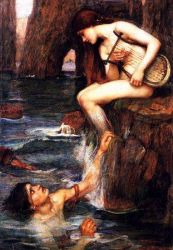
“The ship is coming closer, I can make them out now. They are all standing on the deck, looking at us. I love it when I can see the wonder on their faces. I think the one in red will dive first, he is looking at us like he has been searching for us all his life. I can tell by the light in his eyes, they all get that light in their eyes before they go. He has made up his mind now, he is standing on the edge. Oh, he looks so handsome with the wind rushing through his dark hair, and his muscles straining against the ones that are trying to hold him back. He is in the air now. He looks so free, like he is flying. His red shirt is rippling in the wind as he falls. He is in the water now, he is swimming towards us. Oh sister, I really think that he might be the one to make it, he is so much stronger and more handsome than the ones who have come before. If he makes it, can he be mine? I will warm him with my songs and feed him the delicious golden apples that grow on our island. No, do not stop singing sister, he will drown if you do! Oh no, the waves are getting bigger now, they are crashing over his head, and making his ebony hair drip down over his shoulders. The freezing, tossing waves are turning his beautiful lips blue. I wish that I could go out there and get him and warm up his lips and pull him into the shore. Why can’t I sister, just this once? No, don’t stop singing, he will drown! His arms are getting weaker now, his strokes are slowing down. The look in his eyes is so desperate, as if he knows what is going to happen to him. I wish I could spare him that, at least. Oh, the sea has swallowed him, the weight of the water is pulling him down to the seabed below. He is fighting it, he has come up again. I can see his head bobbing amongst the waves. Isn’t he brave? No, don’t answer me sister, keep singing! He has sunk again… keep singing sister, and he will resurface!”
“It is finished now. He will not return to the surface. It is over.”
“No, don’t say that! He has not been under too long, he could still make it! Please, sing Apollo’s melody again!”
“That would not help, it is too late. They all succumb to it in the end. It just took this one a little longer than usual, that is all.”
“Why didn’t you tell me it would be like this, why didn’t you warn me? How could you let this happen, time after time? Is this what we train for, for years on end? You have spent hours teaching me the most beautiful melodies ever created. All for this… this horror! Why do we use something so beautiful to kill, and to destroy? Didn’t you see his face? He knew, at the end, that he was going to die! All he wanted was to be closer to the beauty of this place, and we let the music kill him!”
“That was not all he wanted, sister. I know that it is hard to come to terms with at first, and I know what it is like to sometimes feel a connection to them, but this is the way of our world. This is the way it has always been, and always will be for us.”
“It just hurts so much. I really wanted this one to make it.”
“We all want that at some point along the line. You will get over it in time, we all do. Soon they will all blur together, and become one and the same. Then you will not feel sad, and you can concentrate on producing the most beautiful, evocative melody that you possibly can. That is what your job is. That is what you were born to do. It is sad, but that is life, and soon you will see that it can be beautiful too. Come, let us go and wait for him to wash up on the rocks.”
“What about the rest of them?”
“We will leave them for now. You have had enough excitement for one day. They will come back another day, they always do. We will sing to them when they return.”
“Can I sing for the next one?”
“Maybe. We will see. Come. Hurry, or else the mermaids will steal him from the rocks before you can say goodbye. They are very sneaky that way. You are lucky that you were not born to be one of them.”
“I know.”


(I stumbled across this short piece that I wrote for an exercise in a writing workshop a couple of years ago. We had to describe a drowning using only dialogue. It later turned into a story, but this is its 'raw' form. Just felt like putting some writing out there.)

Tuesday, December 06, 2005

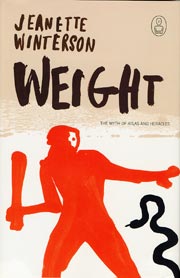
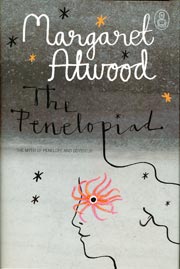
Atwood, Winterson, and Byatt to come... what could be better?


Looks like my summer reading is taken care of... Of course, there's plenty of other things that I need to be reading as well, but Canongate's new myth series is definitely on my Xmas list. I haven't managed to locate Winterson's in the bookshops yet, but Atwood's take on Homer's Odyssey from the perspective of the neglected Penelope looks fantastic. And hey, it makes my masters seem positively trendy...

writing = words = images = sounds = spaces = learning =

I am having a bit of a go at writing a digital narrative at the moment, combining images, words on screen, oral words, movement, music. It ain't easy. It seems to be making all the inherent complications in my usual writing process (words on a page/screen)more... obvious. Which is really interesting. But also difficult. Trying to draw different together in different modes... trying not to think of them as distinct threads while I'm writing, but connected and interwoven... trying not to make it seem too contrived... trying to avoid linearity...
Listening to some spoken word poetry over the past few days has added to the complexity, because I'm more aware of sound and how that can create/add meaning. Too much to grapple with.

I'm probably over thinking it.

Why am I doing this?

Oh, no particular reason...

Monday, November 28, 2005

Spaces (1)


Spaces for professional learning can be hard to come by, and even then they are often subjected to external mandates, guidelines and parameters.

One example of this that I experienced recently was the VIT portfolio process for beginning teachers. I found myself constantly frustrated by the externally imposed measures, proformas and requirements. This was supposed to be about reflection, about thinking and writing about professional identity and learning, and yet the writing that needed to be produced had to be a certain structure, shape… even genre.

On top of this was the added pressure of assessment. I had to produce something that was going to be used to confirm my status as an accepted member of the profession. Suffice to say, moving beyond the mandated parameters of the task- attempting to write on the boundary of something that my school would be happy with, and that I was happy with- was not without risk.


During this experience, and after it, I found myself looking for alternative spaces to write about my teaching and learning. Blogging was one of those spaces. I was resistant to the idea of blogging at first. I read and loitered on the blogs of my friends and colleagues, but was reluctant to begin my own. “Why bother?”, I thought. I have email as a writing space to explore my professional identity. I have a number of communities that I already tap into. With email, I have a relatively captive audience- people who would actually write back (well, it is the polite thing to do). In blogging, there is no guarantee of that. You don’t know who’s reading. You don’t know if anyone is reading.

Blogging seemed to carry a certain degree of risk. It involved stepping out into a newly created digital space and inhabiting it, making it my own. It involved trust- trusting an unknown audience to read, and not to ridicule. Even though I was putting a digital representation of myself out into cyberspace, it also involved a certain amount of secrecy. I chose not to reveal my name, and I only let a few people know about my blog. I was reluctant to let go of at least the illusion of control over my space.

Friday, November 25, 2005

a goosepimply moment while reading on the train...


"A text... with its etymological roots in the Latin 'texere', 'to weave', celebrates a process of becoming."

-Lissa Paul, Reading Other-Ways


Sunday, November 13, 2005

A proud member of 'Generation Lite'

I have been meaning to write this post for some time, and conversations that I have had with a few people over the past week have compelled me to write it somewhere other than in my mind.
The furore surrounding the proposed draft of the VCE English Study design some weeks back and more recently the flare up after the VCE English Exam left me feeling perplexed (ok, maybe completely flabbergasted would be a more appropriate description). There were the predictable missiles fired by the usual neo-liberal suspects that missed the target (see good ol' Kevin's comments in this ridiculous Australian article, and also some ill-considered attacks by others who I feel would probably not want to find themselves in that category (even though their arguments contained very similar, if not identical, rhetoric). Baden Eunson's article is one example of this.

Whenever I read these kinds of arguments filled with all the inflammatory, damning, buzz words- 'crisis', 'the basics', 'dumbing down', 'English lite', 'postmodern pus' (ok, yes, I made that one up) and so on, I become increasingly frustrated as I seek to find a 'way in'. I want to understand the position that the writer has adopted and why. I want to reason with them, to question their understandings in order to question and articulate my own. Unfortunately, it is very difficult to do this because of the assumptions that these arguments are built on. Pull those assumptions away and the entire argument comes tumbling down. Here are a couple of examples of these assumptions:


  • The Basics.
What does this term 'mean' to the people who pepper their writing with it, to the world, to Australia, to communities, to teachers, to students, to me? Is there such a thing? Should the basics be the same thing for everyone? Do we want our students to arrive at the end of their secondary education and say, "well, at least I've learnt the basics"? What are the basics? The 3R's? Grammar, Spelling, Vocab? Are the basics of the 1960's the same basics of the 21st century? Should they be?


  • These basics are not being taught in Victorian/Australian schools.

Well, if the basics that these writers/politicians continuously refer to are spelling, grammatical structures, punctuation and vocabulary (this is what I assume they are referring to based on my interpretation of the gist of their rhetoric), then I can assure them that these concepts are being taught in secondary English classes. This hasn't changed. What has changed since the 1960's is the way that teachers are teaching and students are aquiring these skills. And thank goodness for that. As teachers, we try to cater for the individuals in our classrooms. Of course, reality can never quite match the ideals we aspire to, but this premise still seems to be a good one.Usually, this means that decontextualised spelling lists and grammar exercises (e.g. change the tense of the verb in this sentence about a boy called Dick riding his bicycle to the general store to collect a pint of milk for his dear mother) about topics that a particular student couldn't care less about isn't considered to be the most helpful approach anymore. (Note: this paragraph is based on the assumption that my understanding of 'spelling, grammar, punctuation and vocabulary' is the same as the writers/politicians/researchers I am critiquing. It isn't, but I won't go into that here.)

  • If you can't measure it, bottle it, capture, it, record it... it never happened. In fact, it's completely worthless.

The most frustrating thing about all this is the way that people try to fit a simple template to an incredibly complex and rich process- learning. If we teach X in X way every day for X number of hours then X students will develop X skills to function in X professions. Learning isn't a simple mathematical equation. There are no 'one size fits all' solutions for student learning (and engagement- not that that is worth factoring in here, of course). I find it difficult to understand this desire to simplify and reduce learning communities to banking metaphors- teachers 'depositing' knowledge into students' heads. Why isn't Nelson interested in considering that teachers are professionals who know their students, not mere technicians who can't be trusted to know and understand their students and the communities they work within?

Ugh, I'm sick of this now. Perhaps this isn't an adequate way to argue my point, anyway. Perhaps searching for a 'way in' to this type of reductive thinking- answering back, as it were- only results in defensive arguments, not a powerful and thoughtful exploration of my understanding of learning, engagement and professionalism. Defensive and inadequate arguments are all I seem to have ended up with. I haven't come close to articulating what I really want to write. Perhaps I'm just tired. I'll keep trying though. In other ways, other places, other times.

Saturday, November 05, 2005

The beginning of an End, and the beginning of a Beginning...

Just got home after seeing a film with a friend that I haven't seen in ages. The company was good, but the film was a bit of a shocker. It's a pity really, because the visuals on Elizabethtown's home page are fantastic, but when a website turns out to be better than the film it's supposedly advertising.... well...

I'm missing my year 12's. I only have my year 10's left now and they will be finished soon, too. In fact, next week will probably be my last week of 'real' (ie, my own classes) teaching for a while- I am taking first semester off next year. I want to be able to focus entirely on my thesis over the next six months so that I end up with something decent that I don't feel the urge to wrinkle my nose at every time I walk past it sitting on the shelf for the rest of my life. I also need some time away from school in order to patch myself up after these last couple of months. A bit of healing time, and also time to throw myself headlong into a process that is important to me, before I throw myself headlong into teaching full time. It will be good, but I'm going to miss my students and getting excited over lesson planning (piles of corrections...nah, I can live without them for a while).

Watching my year 12's graduate at the Valedictory Dinner left me with a pretty good feeling. I don't think it's a sight that will ever get old, no matter how many times I see it. And I'm only what, 7-8 years older than them or something. You'd think I was their mother! Well, they were my first year 12 class.

Here is a photo of the 'thank you' present they gave me. The little treasures. They know me too well:

Monday, October 31, 2005

Writing


I can't write. You may think this is what I'm doing now, but you're wrong. There are words, and then there are words. There are no words for what I want to write about. I have started this post four times already. There are hidden words that no one will ever see.

No, I am not writing now. There are words here that are signifiers for something, but this is not writing. It can't be. I am unable to write.


I have been unable to write for some time now.

I am wondering if/when it will feel alright to write again. If/when the words will being to flow again from the writer/soul. If/when the words will mean/reveal what I/the writer want them to. It is strange to think that I am typing, but not writing. The keys rise and fall and letters/codes appear/burn but there is nothing/everything to be made from this.

I don't want to write. That is why I am not writing now.

***

For those of you/whoever you are/whatever you are for whom my posts have been a little obscure lately, I lost a very dear friend/colleague of mine in a tragic/terrible/unnecessary/hateful accident 5 1/2 weeks ago. It feels like so much longer than that. My fellow 'inquiring mind' is gone and there is so much that I want to talk to him about.

Now that I have started to type about it there isn't really anything else that I want to say.

***

Now, you will see that I may start to type again, occasionally, about other things. But don't misunderstand me. I am not writing. Not yet.

Sunday, October 09, 2005

A Nice Moment

On Friday one of my year 10 boys, 'Metallica', knocked on my staffroom door and said,
"Miss nb, I want to take you to lunch."
"Oh really, Metallica? What did you have in mind?"
"I'm making a three course meal for catering and I need someone to eat it."
"Can you cook?"
"Yeah"
"Metallica, that sounds like just what I need. Thank you for asking me."
"Okay, cool, I'll come and collect you in about an hour or so."
"I'll be here."

An hour or so later, I sat down at a beautifully presented table and dined my way through a warm and spicy lentil soup (so good- Metallica has promised me the recipe), fettucine carbonara and pancakes topped with strawberries, kiwi fruit and homemade chocolate sauce. Yum.

A colleague of mine was saying the other day that at times like this, the fact that 'life goes on' is both a blessing and a curse. That certainly feels true at the moment.

Thursday, October 06, 2005

This dead flatness


It's not true that I'm always thinking of H. Work and conversation make that impossible. But the times when I'm not are perhaps my worst. For then, although I have forgotten the reason, there is spread over everything a vague sense of wrongness, of something amiss. Like in those dreams where nothing terrible occurs- nothing that would sound even remarkable if you told it at breakfast time- but the atmosphere, the taste, of the whole thing is deadly. So with this. I see the rowan berries reddening and don't know for a moment why they, of all things, should be depressing. I hear a clock strike and some quality it always had before has gone out of sound. What's wrong with the world to make it so flat, shabby, worn-out looking? Then I remember...
Feelings, and feelings, and feelings. Let me try thinking instead... I knew already that these things, and worse, happened daily. I would have said that I had taken them into account. I had been warned- I had warned myself- not to reckon on wordly happiness. We were even promised sufferings. They were part of the programme. We were even told 'Blessed are they that mourn,' and I accepted it. I've got nothing that I hadn't bargained for. Of course it is different when the thing happens to oneself, not to others, and in reality, not in imagination...

-C.S. Lewis, A Grief Observed

***

I am finding that I can walk into class and laugh when a year 12 kid leaps up from behind his desk, snaps a photo of me mid-teaching, then return to his seat and says, "Sorry- photo for the Valedictory dinner. Carry on, miss".
Then, I wander back into a silent staffroom, and wonder why.

Tuesday, September 27, 2005

Friday, September 16, 2005

Year 11 Lit Texts

I'm teaching year 11 Literature for the first time next year and I get to choose my own text list (how exciting!). This is what I've (semi)settled on at the moment:

Bush Studies, by Barbara Baynton (lots of interesting possibilities)


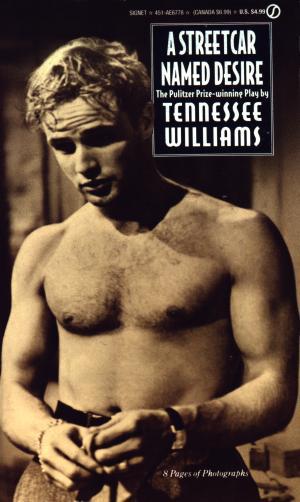
A Streetcar Named Desire, by Tennessee Williams (the play and the film- I love it and the kids will love it)


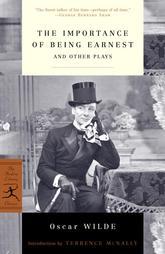
The Importance of Being Earnest, by Oscar Wilde (my colleague taught it this year and the students laughed uproariously all the way through- but that could be because she's really great at the accents)


Songs of Innocence and Experience, by William Blake (interesting comparison possibilities)


The Scarlet Letter, by Nathaniel Hawthorne (love it- rich in symbolism, fascinating context, all that good stuff)


I'm still playing with a few other things, too, like The Crucible, Lambs of God, The Well, Jane Eyre...

I'm a bit worried that I don't seem to have anything really contemporary, though.

Any suggestions/comments?

Thursday, September 15, 2005

Read this. Please.

This is an experiment. I am not necessarily writing what I mean, because I don't know what I mean. I HAVE NO IDEA WHAT I'M DOING. I just want to write and see what happens.

I once wrote a poem using one of those 'magnetic poety' sets. I only had about thirty words to choose from. It was about the sea. NOte: there was more text here, but I deleted it.

In the beginning, there was a girl who loved music and drama. She loved low, resonate notes that hung like fog above the ground, not the twinkling high notes that vanished as if they had never been. This was odd because she was a flautist. She wanted to play notes that didn't exist. No one understood that.

She should have played cello.

She performed a monologue that made people cry. 'This is all I want to do,' she thought to herself. 'I want to make emotion leak out of people.'

In the end, the music warbled away. The voice was replaced with black squiggles on a white sea. Or, perhaps the squiggles were really holes, burnt into the page. Spaces one can slip through.

and what is the other option? the imposter cried. and what are the choices? the misfit sighed.

i don't know she whispered. all i can do is keep tripping across the surface and hope i don't fall
through
the
crevices.

and if you do???

there is always another page lying beneath waiting to be read she said and hoped that it was true.

it is true, the misfit said. i have tried to find the end. i have searched for it in

ATWOODOCONNORRICHBARNESCOETZEETENNYSONSTRAUSSMALORY
CARMODYPLATOH.D.DICKENSSETHWILDEMACGUIRETOLSTOYFOWLES
and many other places but i have never reached the end.

it is therefore a reasonable hypothesis to assume that there isn't one, the imposter assented. a never ending DNA strand

it's true, she exclaimed. i can type and type and type and type meaningless squiggles and the pages never end. a fresh one is always waiting even if all i write is

that is because the page doesn't judge you, the misfit smiled, relieved. isn't that nice? the page is open to anything. anything!

mmm, it's the reader you have to worry about, the imposter grumbled. the reader judges every word. and even when they don't know what you mean they assume that they do. they interrogate you, hunt for misplaced squiggles, criticise your shape, doodle on margins and well, all sorts of awful things really.

but worst of all, the misfit whispered, worse even than the interrogating and the hunting and the criticising and the doodling is

is-s wh-what, she stammered.

worst of all is when they walk past without ever glancing at the page. that is the worst thing.

oh. yes.


See? I told you so. Even when I don't mean them to the black squiggles still take on shapes, definitions. Even if I fight against it. But perhaps I don't fight hard enough. I want to be understood. Even when I'm trying to be elusive I still leave enough clues strewn across the space for people to put a picture together. Even if it clashes with the picture in my head. There are still common brushstrokes, similar tints. Tricky, isn't it?

yes, said the misfit

Saturday, September 03, 2005

What is English?

What is English? How do we define it within a shifting and fragmented world?


How do we address the inherent challenges in attempting to avoid definition?


How do we challenge the reductive definitions and control foisted upon us by policy makers and government bodies?


How do we prepare our students to engage critically with a world that won’t stand still?


In a textual world where classics, visuals, voices, games, comics, poems, hypertexts, blogs, ezines, newspapers and cultural trends continue to overlap and merge, leaning on each other for room, how can subject English ever be defined?

Crafty Coetzee


While reading the Review section of The Age this morning and crunching on toast with peanut butter and honey, I discovered that J.M. Coetzee's latest novel, Slow Man, is now on sale. Naturally, that meant I had to dash down to Borders to get it, even though I'm not sure exactly when I'll get to read it.

Coetzee and I have had a bizarre, one-sided love-hate relationship over the last few years. He infuriates me- I hate what he does to his female characters in particular- and yet I am continually drawn to his crisp, precise prose that I could never hope to emulate and don't particularly want to.

The first book of his that I read was Youth. It provoked such a strong reaction from me, to the point where I would feel the need to wash my hands after I had put it down. There were times when I wanted to stab forks through its pages, and other times when I felt like pinning it to the clothesline and watch it slowly succumb to the weather from the relative safety of my bedroom window. And yet, there is a moment in that text that has stayed with me over the years and pops into my mind at odd times when I least expect it. It is the horrific, yet oddly tender reflection from a father on his aborted child:


His thoughts keep going to what was destroyed inside her- that pod of flesh, that rubbery manikin. He sees the little creature flushed down the toilet at the Woodstock house, tumbled through the maze of sewers, tossed out at last into the shallows, blinking in the sudden sun, struggling against the waves that will carry it out into the bay. He did not want it to live and now he does not want it to die. Yet even if he were to run down to the beach, find it, save it from the sea, what would he do with it? Bring it home, keep it warm in cotton wool, try to get it to grow? How can he who is still a child bring up a child?
He is out of his depth. He has barely emerged into the world himself and already he has a death chalked up against him. How many of the other men he sees in the streets carry dead children with them like baby shoes slung around their necks?


Phew. See what I mean?

Slow Man is another experiment in metafiction for Coetzee (a genre that I find fascinating). Apparently, the central character from his last novel, the elderly writer Elizabeth Costello from the novel of the same name (a woman who I wanted to rescue from the very pages that she had been created within- damn Coetzee and his arrogant, assuming treatment of female characters) appears in this new novel, quite unexpectedly, which allows Coetzee to examine the nature of the creative process. ("Postmodern shenanigans" is what one reviewer termed this device). Slow Man is also supposed to continue in the more overtly philosophical vein of his recent books, which I quite enjoy but some reviewers seem to abhor.

There have been a few quite interesting and contradictory reviews published:

Kerryn Goldsworthy for The Age

Sarah Emily Miano for The Times

D J Taylor for The Independent

Robert Macfarlane for the Sunday Times

Looks like it will be an interesting journey...